Latest Posts
The Sentinel of Santa Catalina Island
On the sun-drenched isle of Santa Catalina, where the trade winds whispered secrets to the sea, lived a man named Luis. His life, like the tides, was a simple, rhythmic affair, governed by the pull of the moon and the bounty of the deep. Yet, his true compass was not a brass instrument in a mahogany box, but a solitary palm tree that stood upon the eastern point of the island.
This was no ordinary palm. It did not stand tall and straight like its brethren, aspiring to the heavens. Instead, it leaned precariously over the white sand, its trunk curving in a graceful, impossible arch towards the turquoise water. It was as if the tree, in a fit of youthful rebellion, had decided to defy gravity itself, a silent sentinel forever frozen in a bow to the ocean. Luis had known this tree since he was a boy, when his legs were barely long enough to outrun the foamy tendrils of the surf.

In those days, the tree was his confidant. He would sit beneath its improbable shade, the sand cool between his toes, and tell it of his dreams—of the great fish he would catch, of the storms he would weather, of the man he would become. The tree, with its fronds rustling in the breeze, seemed to listen, its leaning form a silent promise of unwavering support. He called it “The Sentinel,” for it watched over the island, a singular landmark visible from leagues away.
As Luis grew, so did his bond with the Sentinel. He became a fisherman like his father, venturing further and further into the vast, indifferent ocean in his small wooden boat. The sea was a fickle mistress, its moods changing with the wind, but Luis never feared getting lost. No matter how far he sailed, when he turned his gaze back towards Santa Catalina Island, he would scan the horizon until his eyes found it—that distinct, leaning silhouette against the sky.
“A man with a beacon,” he would say to his fellow fishermen, with a characteristic twinkle in his eye, “is a man who can never truly be lost.” They would nod, for they, too, used the leaning palm as their guide. It was a fixture of their world, as constant as the North Star, and far more tangible. It was their lighthouse without a lamp, their compass without a needle.
There was one night, many years ago, when the sea decided to test Luis’s faith. A tempest, sudden and violent, descended upon him. The sky turned a bruised purple, and the waves, whipped into a frenzy, threatened to swallow his small craft whole. Rain lashed at his face, blinding him, and the wind howled like a banshee. Luis, for all his experience, felt the cold hand of fear grip his heart. He was disoriented, tossed about like a cork in a washing tub. He had no idea which way lay the safety of Santa Catalina Island.

In the midst of the chaos, he did the only thing he could. He prayed. Not to any god of the sea or sky, but to his Sentinel. “Guide me,” he whispered into the teeth of the gale. “Show me the way home.” And then, as if in answer to his desperate plea, a bolt of lightning ripped across the sky, illuminating the horizon in a flash of electric white. There it was. A faint, dark silhouette against the illuminated clouds, leaning in its own peculiar way. Hope, fiercer than the storm, surged through him. He wrestled with the tiller, turning his boat towards that single point of reference. He fought the waves for hours, his muscles screaming, his eyes fixed on the Sentinel. It was a grueling battle, but he made it back to the calm waters of the lagoon just as dawn was breaking. The tree had saved him.
Years turned into decades, and Luis’s hair turned the color of sea foam. He married a woman named Maria, whose laughter was as bright as the island sun, and together they had a son, Miguel. One warm afternoon, when Miguel was old enough to understand, Luis took him by the hand and led him to the eastern point. The boy, with eyes as wide and curious as the sea itself, looked up at the strange, leaning tree.
“Papa, why does this tree look like it’s falling down?” Miguel asked, his small hand tracing the rough bark of the trunk.
Luis chuckled, a deep, resonant sound that seemed to come from the depths of his chest. He sat down in the sand, pulling his son onto his lap. “It is not falling, mijo. It is bowing. It bows to the ocean, which gives us our life. But more than that, this tree is my oldest friend.”
Miguel’s brow furrowed in confusion. “A tree can’t be a friend, Papa.”
“This one is,” Luis said, his voice softening with a memory. “Many years ago, before you were born, I was caught in a terrible storm. The waves were mountains, and the wind screamed like a wounded animal. I was lost, Miguel. Truly lost. I thought I would never see this island again.”
“Were you scared?” the boy whispered, his eyes wide with a mixture of fear and awe.
“I was terrified,” Luis admitted. “But then, a flash of lightning lit up the sky, and I saw this tree. Just a black shape against the clouds, but I knew it was my Sentinel. It showed me the way home. If not for this tree, I would not be here today. And neither would you.”
Miguel looked at the tree with new respect, his small hand patting the trunk gently. “Thank you, Mr. Tree,” he said solemnly.
Luis smiled, his heart full of love for his son and gratitude for his silent guardian. He leaned back against the trunk, closing his eyes, content in the company of the two things he loved most in the world. The sun was warm on his face, the gentle lapping of the waves a soothing lullaby.
Suddenly, a sharp crack echoed through the peaceful afternoon. It was a sound Luis knew well—the sound of a heavy coconut detaching from its stem. Before he could even open his eyes, a large, fibrous coconut slammed into the sand with a dull thud, inches from Miguel’s head. Sand sprayed into the boy’s face, and he let out a startled cry.
Luis was on his feet in an instant, his heart pounding in his chest. He scooped Miguel into his arms, checking him frantically for injuries. The boy was shaken, crying softly, but unharmed. Luis looked down at the coconut, half-buried in the sand, then up at the fronds of the Sentinel, rustling innocently in the breeze. A cold, hard rage began to coil in his stomach.
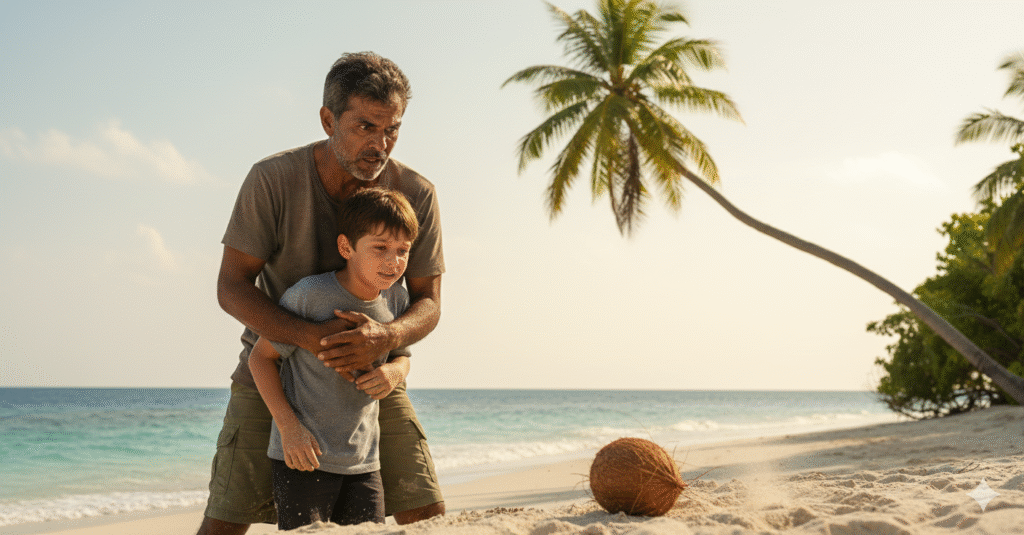
“Are you okay, mijo?” he asked, his voice trembling.
Miguel nodded, wiping sand from his tear-streaked face. “I think so. It just scared me, Papa.”
Luis held his son tight, a fierce, protective instinct overriding all reason. He looked at the tree, his friend, his savior, and felt only a blinding anger. It had almost killed his son. The very thing he had worshipped, the beacon that had guided him home, had turned on him. It was a betrayal of the deepest kind.
“It’s okay, Miguel,” he said, his voice cold and hard as granite. “It won’t hurt you again.”
He carried his son back to their small hut, his mind a whirlwind of fury. He didn’t sleep that night. The image of the coconut hitting the sand, inches from his son’s head, played over and over in his mind like a tortured film loop. The Sentinel was no longer a guardian; it was a threat.
The next morning, before the sun had fully risen, Luis marched to the eastern point. In his hand, he carried a long, jagged saw. The air was cool and damp, the sky a soft palette of pinks and oranges. The Sentinel stood silhouetted against the dawn, leaning as it always had, a silent witness to the coming day.
Luis didn’t hesitate. He didn’t offer a prayer of forgiveness or a word of goodbye. He attacked the trunk with a savage intensity, the saw biting deep into the fibrous wood. Sweat dripped from his brow, mixing with the sawdust that clung to his skin. Each stroke was a release of the anger that had festered in him all night. He sawed with the strength of a man possessed, driven by a primal need to protect his own.
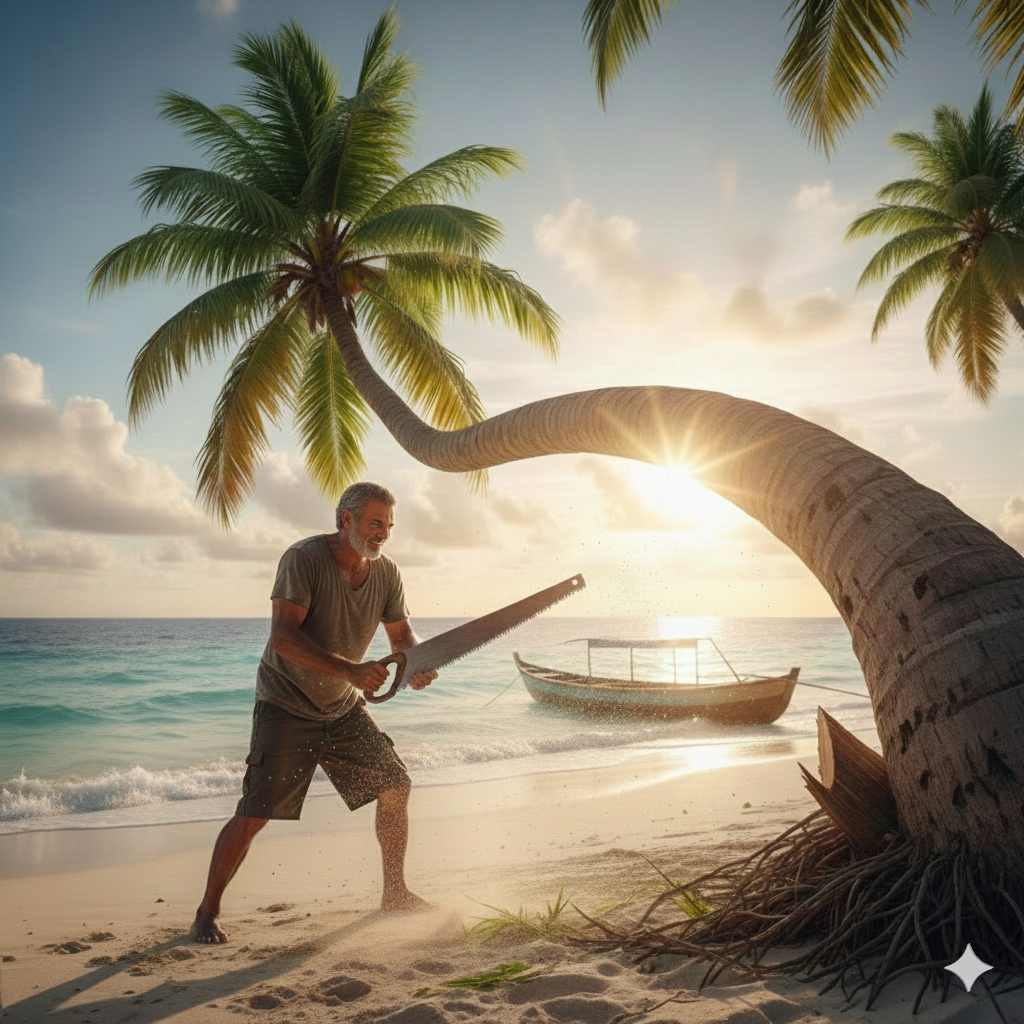
The tree groaned, a low, mournful sound that seemed to vibrate through the very ground. Then, with a final, resounding crack, the Sentinel fell. It crashed onto the sand, its proud arch broken, its fronds splayed out like the feathers of a fallen bird.
The silence that followed was deafening. Luis stood over the fallen giant, his chest heaving, the saw still clutched in his hand. The red mist of anger began to clear, replaced by a creeping, icy dread. He looked at what he had done. He had destroyed the landmark that had defined his life, the beacon that had saved him. He had killed his oldest friend.
A wave of regret, powerful and nauseating, washed over him. He dropped the saw and fell to his knees beside the fallen trunk. He ran his hand over the rough bark, just as his son had done the day before. tears streamed down his weathered cheeks, falling onto the wood.
“What have I done?” he whispered, his voice choked with emotion. “God forgive me, what have I done?”
The islanders were shocked when they saw the fallen Sentinel. It was as if a piece of the island itself had been ripped away. They looked at Luis with a mixture of pity and disbelief, unable to understand why he would destroy the very thing that had guided them all for so long. Luis offered no explanation. He retreated into himself, a shadow of the man he had been. The guilt gnawed at him, a constant, aching void in his soul.
Months passed, but the wound did not heal. The eastern point of Santa Catalina Island was now a barren stretch of sand, the absence of the Sentinel a glaring reminder of Luis’s folly. He continued to fish, but the joy had gone out of it. Every time he looked towards the shore and saw the empty horizon, a fresh wave of pain would wash over him.
One evening, before setting out for a night of fishing, Luis sat with Maria on the porch of their hut. The sun was setting, painting the sky in fiery hues, but Luis’s eyes were dull and listless.
“Luis,” Maria said softly, placing a hand on his arm. “You must forgive yourself. It was an accident. You were protecting our son.”
Luis shook his head slowly, his gaze fixed on the distant, empty point. “It was no accident, Maria. It was anger. Pride. I destroyed the only thing that never asked for anything in return. I feel… I feel naked without it out there.”
“You are a good man, Luis,” she insisted, her voice fierce with love. “A good father. Do not let one mistake define you.”
He looked at her, his eyes filled with a profound sadness. “Some mistakes, Maria, you cannot unmake. Some things, once lost, are lost forever.”
He kissed her gently on the forehead and walked down to his boat. He pushed off from the shore, the small craft gliding silently over the dark water. He set his course for the deep waters beyond the reef, the familiar rhythm of the sea offering a small measure of comfort.

The night began peacefully enough. The stars were a canopy of diamonds overhead, and the moon cast a silvery path across the water. But as the night wore on, the wind began to pick up, and the air grew heavy and thick. Clouds rolled in, obscuring the moon and stars, and the sea became restless.
Luis felt a familiar knot of tension in his stomach. He had seen these signs before. A storm was brewing, and it would be a bad one. He pulled in his lines and turned the boat towards home, his eyes automatically scanning the horizon for the comforting silhouette of the Sentinel.
But there was only darkness.
The storm hit with a vengeance. It was a tempest that rivaled the one from his youth, a swirling vortex of wind and rain that battered his small boat mercilessly. The waves rose up like angry giants, crashing down around him with the force of a hammer. Luis fought the tiller, his muscles screaming with effort, but it was a losing battle.
Without the Sentinel, he had no point of reference. The horizon was a blur of rain and spray. Every direction looked the same—a terrifying expanse of angry sea. Panic, cold and sharp, began to rise in his throat. He was lost.
“Guide me,” he whispered into the roaring wind, just as he had all those years ago. But this time, there was no answer. No flash of lightning to illuminate a friendly form. Only the relentless howl of the storm and the crashing of the waves.
He tried to navigate by the feel of the wind, by the direction of the waves, but the storm was a chaotic beast, its patterns unpredictable. He was spun around, tossed this way and that, until he had no idea which way was north, south, east, or west. He was a speck of dust in a maelstrom, entirely at the mercy of the elements.
Hours passed, each one an eternity of struggle and fear. Luis’s strength was failing. His arms were numb, his body battered and bruised. He knew he couldn’t hold on much longer. The boat was taking on water, its small frame groaning under the strain.
As the first gray light of dawn began to seep into the sky, Luis looked out one last time. He hoped, with a desperate, illogical hope, to see the familiar leaning form of the Sentinel on the horizon. But there was nothing. Only the endless, churning gray of the sea.
A wave, larger than any that had come before, loomed over the small boat. Luis looked up at it, a strange sense of calm washing over him. He had made his choice. He had destroyed his savior in a fit of rage, and now, the sea was coming to claim its due.
The wave crashed down, engulfing the small boat in a mountain of white foam. Luis was thrown into the water, the cold shock of it stealing his breath. He fought for a moment, kicking towards the surface, but the sea was too strong. It pulled him down, down into the crushing darkness.
The storm raged on for another day, then, as quickly as it had come, it vanished. The sun rose over Santa Catalina Island, bathing the white sand beaches in golden light. The islanders emerged from their homes, surveying the damage. Trees were down, roofs were damaged, but they had survived.
They waited for Luis to return. They waited through the day and into the night. Maria stood on the shore, her eyes scanning the horizon, her heart heavy with dread. But the sea remained empty.
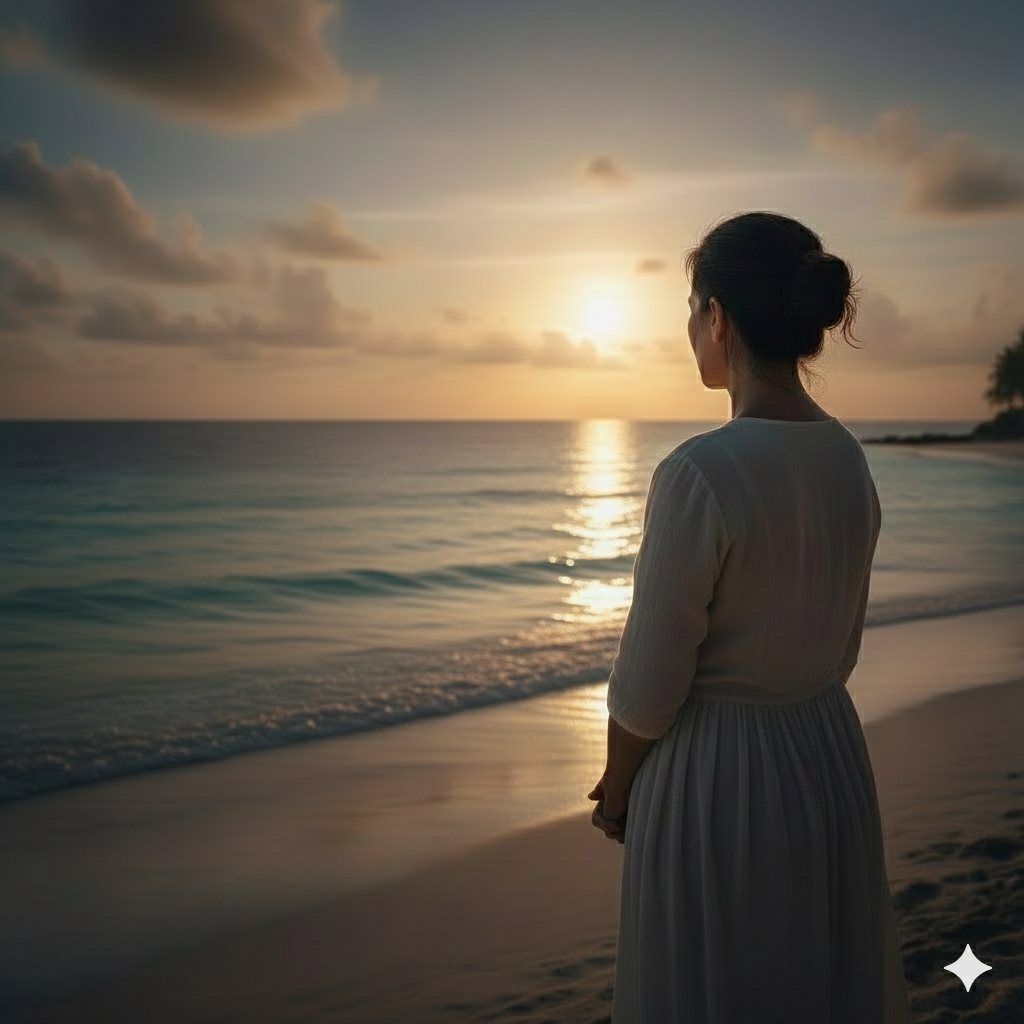
Days turned into weeks, and weeks into months. Luis never returned. His small wooden boat was never found. He had become part of the ocean, another story whispered by the trade winds.
On the eastern point of the island, the sand was smooth and unbroken. The spot where the Sentinel had stood was empty, a blank space on the canvas of the sky. The islanders still fished, and they still navigated by the stars and the currents, but something had been lost. A sense of security, a silent promise of guidance, was gone forever.
And so, the story of Luis and his Sentinel became a legend on Santa Catalina Island. It was a tale told to young fishermen, a cautionary story about the dangers of anger and the importance of respecting the things that guide us. They would point to the empty eastern point and say, “That is where the Sentinel stood. It saved Luis once, and he repaid it with death. And when he needed it most, it was not there to save him again.” The sea is a vast and unforgiving place, they would say, and a man without a beacon is a man who is already lost.
Gallery
Snapshots from recent articles and user interactions on testing site.

User Love
”I love how easy it is to read and comment on articles here. The editing feature for my own posts is a game changer!”